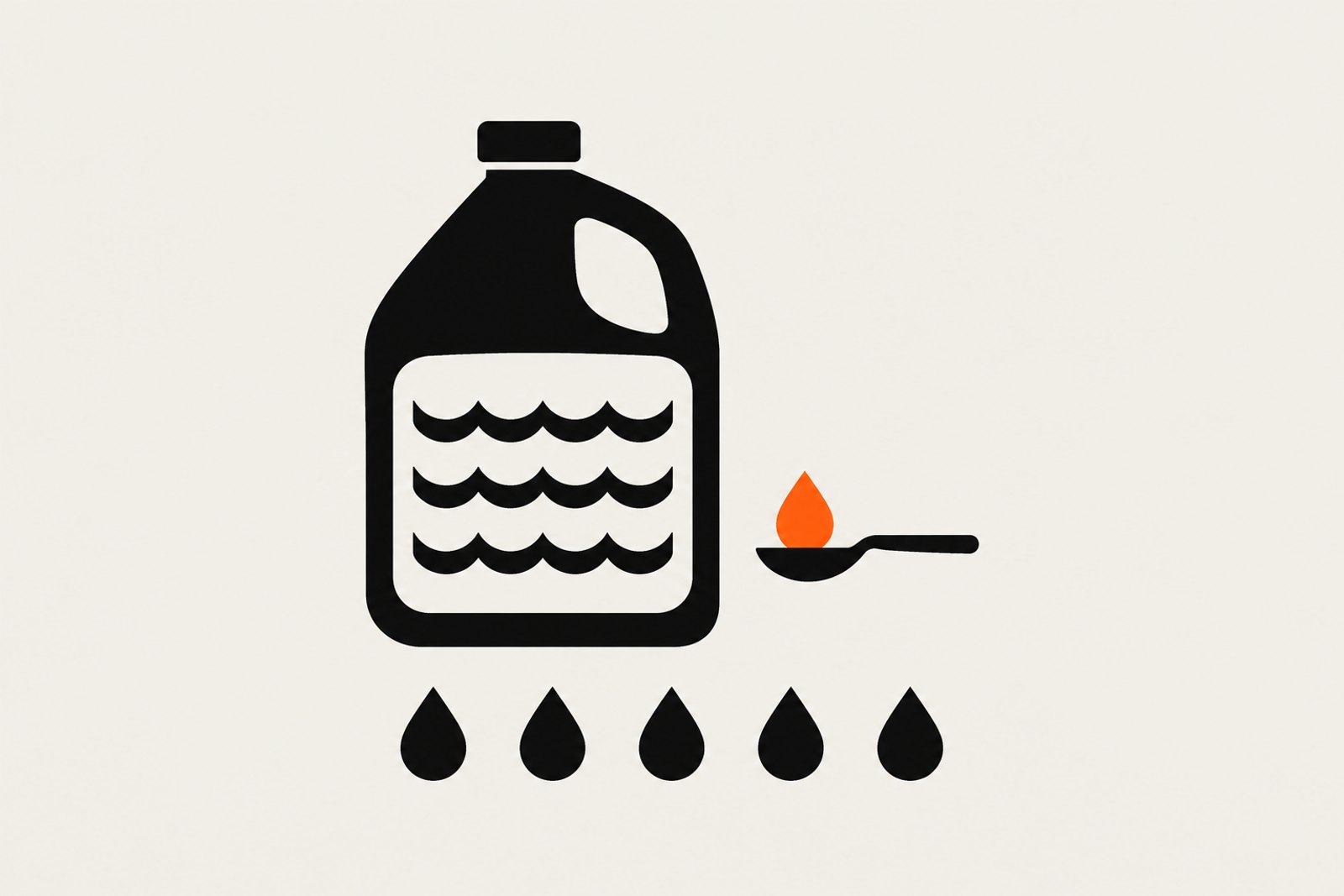
Picture a plain gallon jug from the grocery store, the kind you grab for the road trip cooler. Imagine that it holds every drop of water on Earth: every ocean, every glacier, every lake and the water under your feet. It is full to the neck.
Now pour out the part you could drink without treating it first. You do not need a glass. You may not even need a spoon.
Shrinking the planet to a jug
The U.S. Geological Survey estimates there are about 332.5 million cubic miles of water on, in and above Earth (USGS). A U.S. gallon holds 3,785 milliliters, or 768 teaspoons. Scale all of Earth’s water down to that jug, and each percent of the planet’s water becomes about 7.7 teaspoons.
The oceans take up 96.54% of the water (USGS). That is about 741 teaspoons, or nearly the whole jug. Only a sliver is left over for everything else.
The fresh part: about six tablespoons
Freshwater is about 2.5% of the total (USGS). In our jug, that is about 19 teaspoons, or a little over six tablespoons. Not even a small coffee mug. It is about 95 milliliters, or just over three fluid ounces.
The rest is salt water. The fresh part is the water that crops, cities and most living things on land rely on.
Most of that spoonful is locked away
Here is where it gets thin. Of all that freshwater, 68.7% is frozen in ice caps, glaciers and permanent snow, and 30.1% is groundwater (USGS). That leaves a little over 1.2% of freshwater as surface water in lakes, rivers and similar places.
| Where the water is | % of all water | In a 1-gallon jug |
|---|---|---|
| Oceans, seas and bays | 96.54% | about 741 teaspoons |
| Ice caps, glaciers, permanent snow | 1.74% | about 13 teaspoons |
| Fresh groundwater | 0.76% | about 6 teaspoons |
| Fresh lakes and rivers | about 0.007% | about 5 drops (a quarter of a milliliter) |
The USGS puts fresh surface water at roughly 22,300 cubic miles, about one-hundred-fiftieth of one percent of all water. In the jug, that is about a quarter of a milliliter. Using a common kitchen rule of about 20 drops per milliliter, that is roughly five drops. Rivers alone are 0.0002% of the total, less than a fifth of one drop.
All the lakes and rivers on Earth would fit in the cap of a gallon jug, with room to spare.
financenexttemp.com/, our own line (not a quotation)
Why the five-drop number is not the whole story
This is the part where the obvious takeaway needs a correction. Five drops sounds like we are about to run out. We are not, at least not because of this number.
The USGS table shows how much water sits in each place at one moment. It is a stock, like the balance in a bank account. But water moves. Sun lifts it from the oceans, rain and snow bring it back down, and rivers and lakes are refilled again and again. A small standing amount that is constantly renewed can supply far more than its size suggests.
The jug picture also shows only a snapshot. Groundwater, at about six teaspoons, is the biggest part of freshwater that people can easily reach, but much of it sits deep or is slow to refill. Ice holds the most freshwater by far, yet it is mostly in places far from where people live. The USGS calls its table “one estimate,” and other researchers may count slightly differently, so treat every figure here as a good approximation, not an exact measurement.
What the picture is really good for
The jug does not tell you whether there is enough water. That depends on where it is, how clean it is and how fast it is replaced. What it does tell you is why water is a local problem. The usable share is tiny, and it is unevenly spread, so a dry region cannot simply borrow from the ocean.
It also explains why water treatment and conservation matter at all. When the amount you can easily use is a few drops from a gallon, every drop that is kept clean counts for more.
The short version
Earth is a blue planet, but most of that blue is salt. In a gallon jug, the fresh water is about six tablespoons and the lakes and rivers are about five drops.
Sources
- U.S. Geological Survey, “How much water is there on Earth?”, Water Science School (one estimate of global water distribution). link
- U.S. Geological Survey, “Where is Earth’s water?”, Water Science School. link
- Unit conversions (1 U.S. gallon = 128 fluid ounces = 768 teaspoons = 3,785 mL; about 20 drops per mL) computed by financenexttemp.com/; the drop count is an approximation.