The federal government spent about $7.4 trillion in fiscal year 2026. Try to say that number out loud and it goes slippery. Trillions have no feel.
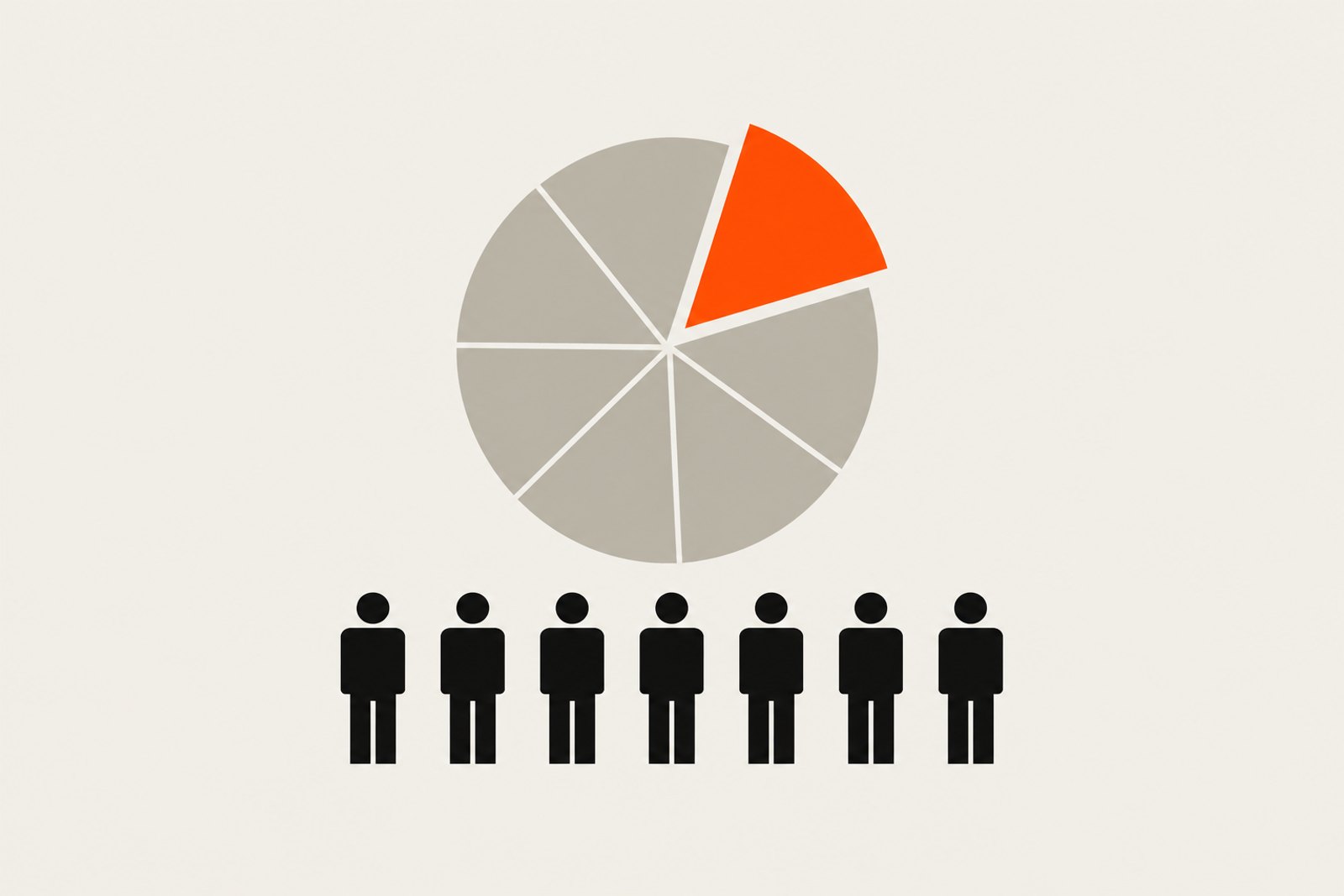
So shrink it. Pretend the whole budget is one dollar bill, and ask how many cents land where. The answer holds one real surprise, and it sits in the interest line.
One dollar, sliced
The Treasury’s Monthly Treasury Statement lists federal outlays by category. For fiscal year 2026, which ended September 30, 2026, total outlays were $7,395.8 billion (Treasury, 2026). Dividing each category by that total gives the cents below.
| Where the dollar went, FY2026 | Billions | Cents per $1 |
|---|---|---|
| Social Security | $1,667 | 22.5 |
| Medicare | $1,073 | 14.5 |
| Net interest on the debt | $1,052 | 14.2 |
| Health (a Treasury category that includes Medicaid) | $1,026 | 13.9 |
| National defense | $965 | 13.1 |
| Income security (such as food and housing aid) | $694 | 9.4 |
| Veterans benefits and services | $416 | 5.6 |
| Everything else, net | $503 | 6.8 |
“Everything else, net” is our own remainder. It covers education, transportation, science, justice, farm programs and more, and it is net of a separate Treasury line of offsetting receipts (-$155 billion, or -2.1 cents).
Now picture the dollar as ten dimes. Two of them and a bit more go to Social Security. Roughly three more pay for Medicare and health programs. One dime and a bit pays for defense, and one and a bit pays interest to the people and institutions that hold federal debt. That is our own rounding of the table above.
Interest passed defense
Look at the table again. Net interest, at $1,051.8 billion, was larger than national defense at $965.2 billion. Interest ranked third among the big lines, behind Social Security and Medicare.
It was not always that way. Here is net interest in three different years, from the same Treasury table.
| Fiscal year | Net interest | Share of total outlays |
|---|---|---|
| 2016 | $240.7 billion | 6.2 cents |
| 2021 | $352.3 billion | 5.2 cents |
| 2026 | $1,051.8 billion | 14.2 cents |
In dollars, net interest rose about 4.4 times in ten years ($1,051.8 billion divided by $240.7 billion). From FY2025 to FY2026 alone it rose 8%, from $970.4 billion (Treasury, 2026).
Why the 2021 dip is a trick of the denominator
Here is the complication. The share fell from 6.2 to 5.2 cents between 2016 and 2021 even though interest rose in dollars. The reason is the bottom of the fraction. In FY2021 the whole budget swelled to $6.8 trillion, and income security alone reached $1.65 trillion, more than double its FY2026 level (Treasury, 2021 and 2026).
So a share can fall because something else grew, not because the thing itself got cheaper. The reverse is also true. In 2026 the interest share jumped because the interest bill itself grew, not because the rest of the budget shrank.
A slice can shrink because the pie grew. Check the dollars before you trust the cents.
financenexttemp.com/ (our own line, not a quotation)
A dollar of spending is not a dollar of taxes
One more twist. The government did not collect $7.4 trillion. Receipts in FY2026 were $5,403.3 billion, about 73 cents for every dollar spent. The gap, $1,992.5 billion, is the deficit. The Congressional Budget Office put the FY2026 deficit at $2.0 trillion (CBO, 2026).
Put another way, net interest equaled about 19.5% of everything the government collected ($1,051.8 billion divided by $5,403.3 billion), close to 20 cents of each dollar of receipts. That is our own comparison, and it mixes two different yardsticks, so treat it as a rough sense of scale.
These categories are also broad. Treasury lists Medicare on its own line and “Health” on another. A source that lumps health programs together will show a different slice from ours, though the dollars underneath are the same.
What to take from it
Almost half of every federal dollar, about 51 cents, went to Social Security and the big health programs in FY2026 (22.5 plus 14.5 plus 13.9). Defense took about 13 cents. And interest, which barely registered in the dollar a decade ago, is now a main character.
The budget is huge, but a dollar is easy to read. Read it before you argue about it.
For illustration only. Not financial advice.
Sources
- U.S. Department of the Treasury, Bureau of the Fiscal Service, “Monthly Treasury Statement”, Table 9 (Summary of Receipts and Outlays of the U.S. Government by Function), September 2026, FY2016, FY2021 and FY2026 year-end figures, via Fiscal Data API. link
- Congressional Budget Office, “Monthly Budget Review: Summary for Fiscal Year 2026”, November 9, 2026. link