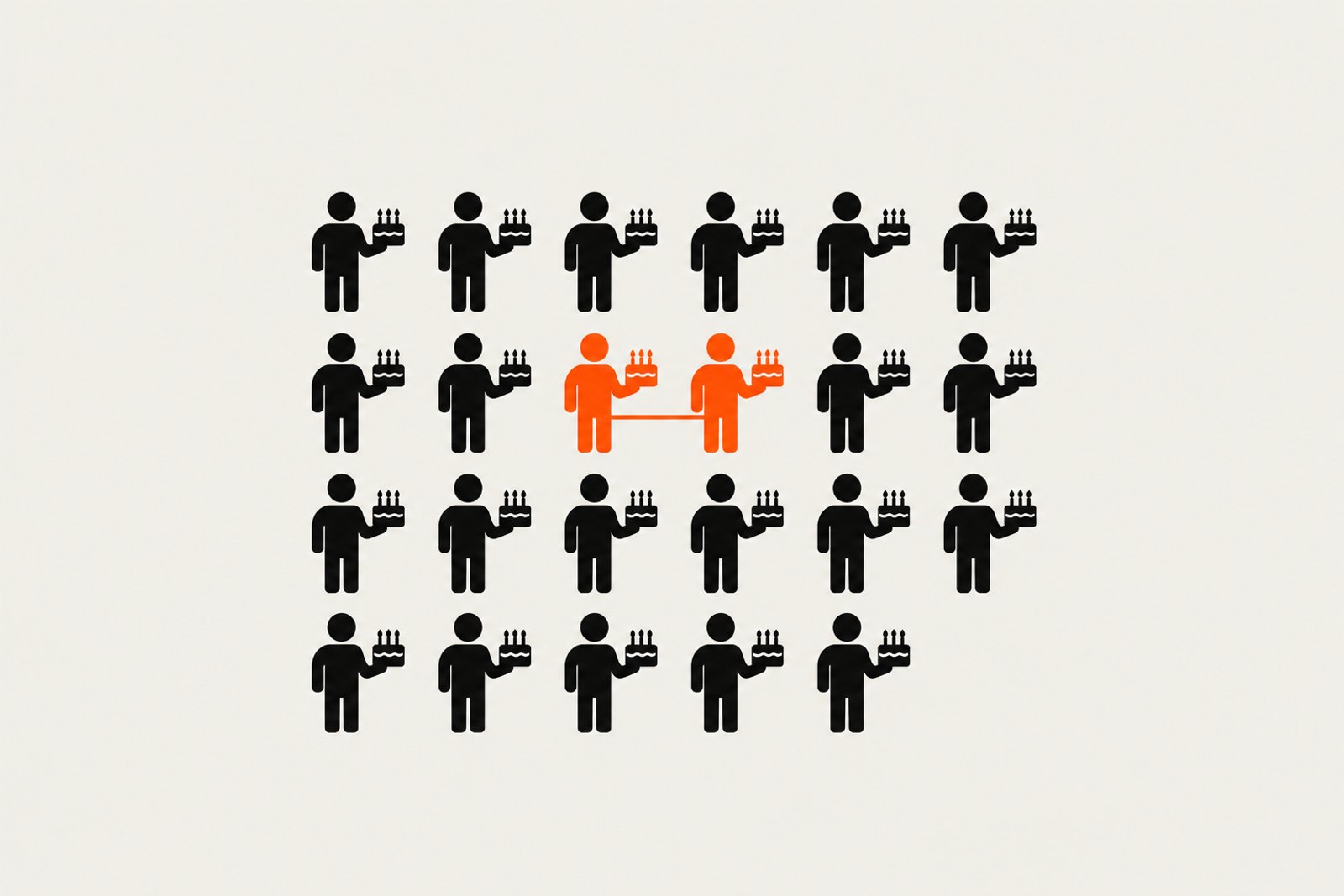
Picture a school gym on a Friday night. Twenty-three parents are scattered across the bleachers, waiting for a basketball game to start. Someone jokes that nobody here could possibly share a birthday. Odds are, the joke is wrong.
It feels wrong to say so. There are 365 days in a year and only 23 people. Surely most days sit empty. But the chance that at least two of those parents share a birthday is about 51%. Better than a coin flip, in a room you could count on your fingers and toes.
Count pairs, not people
Our gut compares each person with us. That is 22 comparisons, and the chance that any one stranger shares your birthday is tiny: 1 in 365, or about 0.27%.
But a match can happen between any two people in the room. Not just you and someone else. With 23 people, that is 23 × 22 ÷ 2 = 253 different pairs (Wikipedia, “Birthday problem”). Each pair is a small lottery ticket. Add up 253 tickets and the odds stop looking small.
The math, in plain steps
The trick is to flip the question. Ask how likely it is that nobody matches, then subtract from 100%.
Person one can have any birthday. Person two must avoid that one day: 364 out of 365 choices. Person three must avoid two days: 363 out of 365. And so on. Multiply those fractions together for 23 people and you get about 49.3%. That is the chance of no match at all. So the chance of at least one match is 100% − 49.3% = 50.7% (University of Washington CSE 312 notes, 2026; our own calculation agrees).
The fractions shrink slowly at first, then faster. Every new person has fewer free days to land on and adds more pairs than the last one did. The 23rd person alone adds 22 new pairs.
How fast it climbs
| People in the room | Pairs | Chance of a shared birthday |
|---|---|---|
| 10 | 45 | 11.7% |
| 23 | 253 | 50.7% |
| 30 | 435 | 70.6% |
| 50 | 1,225 | 97.0% |
| 70 | 2,415 | 99.9% |
Values computed with the standard 365-day model (leap day ignored). Wikipedia’s table gives the same 50.7% and 99.9% figures.
It works on real teams
Soccer is a handy test. Each squad at the 2014 FIFA World Cup had exactly 23 players. Of the 32 squads, 16 had at least one pair of teammates sharing a birthday. Five of those had two pairs: Argentina, France, Iran, South Korea and Switzerland (Wikipedia, “Birthday problem”). Sixteen out of 32 is exactly half. The theory predicted about 51%.
Your brain counts people. The math counts pairs.
Our own line, not a quotation
Where the “paradox” gets complicated
The 50.7% figure rests on a tidy assumption: every day is equally likely to be a birthday, and nobody is born on February 29. Real life is messier. Births bunch up in some seasons and on some weekdays.
You might guess that this ruins the result. It does the opposite. Mathematicians have shown that uneven birthdays make a match more likely, not less. A perfectly even calendar is the hardest case for a match. In practice the real-world unevenness is not big enough to move the answer: 23 people is still the tipping point (Borja and Haigh, Significance, 2007, as cited by Wikipedia).
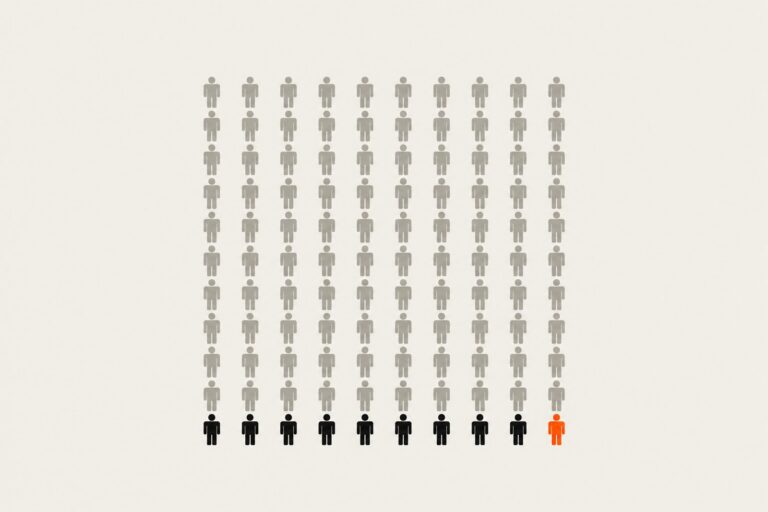
And one more twist. The number 23 answers a specific question: any two people, any day. Ask a different one, such as “will somebody share my birthday?”, and the answer changes sharply. To have even odds that someone matches yours, you would need a crowd of roughly 253 people, not 23. The math is the same. The question is different, and our gut quietly swaps one for the other.
Why this matters outside the party trick
Coincidences are far more common than they feel, because we rarely count how many chances they had. Computer scientists use the same math, called a birthday attack, to estimate how likely two different files are to produce the same digital fingerprint. Fish biologists have used related logic to estimate fish populations from how often the same fish turns up twice.
Next time two people at a table discover the same birthday, you can tell them it is not spooky. With 253 pairs in a room of 23, it would be odd if it never happened.
Crowds hide pairs. Pairs make coincidences common.
Sources
- Wikipedia, “Birthday problem” (probability table; 253 pairs; 2014 FIFA World Cup squads; non-uniform births), accessed 2026. link
- University of Washington, CSE 312 course notes, “Birthday Paradox”, 2026. link
- Borja, M. C. and Haigh, J., “The birthday problem”, Significance, 2007 (cited via Wikipedia). link