
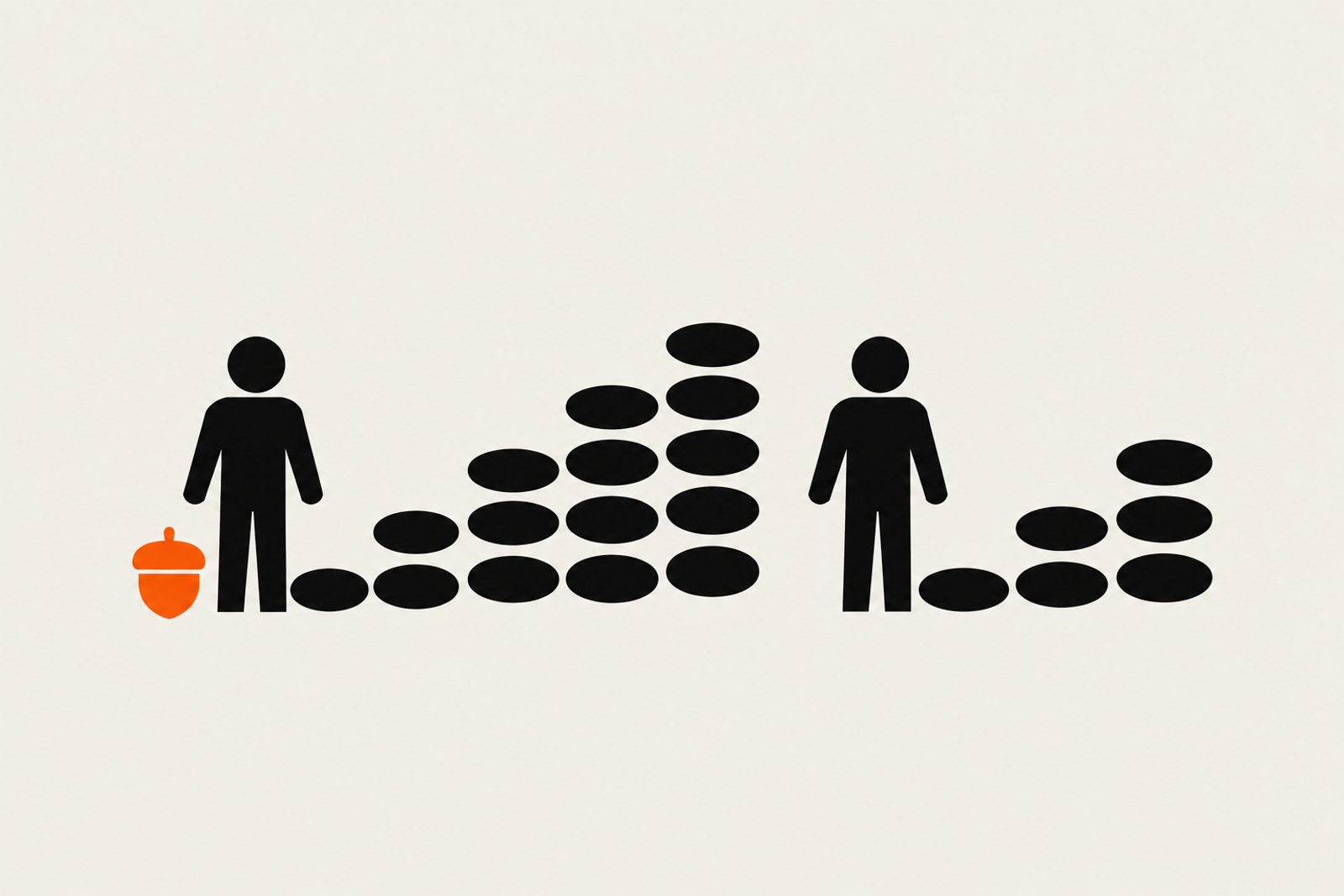
Two friends, Alex and Blair, are both reading the same retirement article. Alex is 25. Blair is 35. Both decide to put aside $300 a month until age 65. Alex has been at the game for ten more years. How much of a difference could that make?
Not ten years’ worth. A lot more. This is a math example, not a forecast, so every rate below is a made-up illustration. Here is how the numbers play out.
The setup
Alex saves $300 a month from age 25 to 65: 40 years, $144,000 in total contributions. Blair saves the same $300 a month from age 35 to 65: 30 years, $108,000 in total. Blair puts in $36,000 less. The money grows at a steady yearly rate, compounded monthly, and we show three illustrative rates. Real markets are bumpy, and no fees or taxes are included here.
| Illustrative yearly growth | Alex (starts at 25) | Blair (starts at 35) | Alex’s lead |
|---|---|---|---|
| 5% | $457,800 | $249,700 | $208,100 |
| 7% | $787,400 | $366,000 | $421,500 |
| 9% | $1,404,400 | $549,200 | $855,200 |
| Dollars put in | $144,000 | $108,000 | $36,000 |
At 7%, Alex ends up with more than twice as much as Blair, and the gap is nearly 12 times the extra $36,000 Alex put in. The higher the assumed rate, the bigger the head start looks.
Why the first decade is special
The extra gap comes from one thing: the first ten years of Alex’s savings, $36,000 in all, get 30 more years to compound. Those early dollars do not just sit there. They earn money, and that money earns money.
The math says something striking. Imagine a third person, Casey, who saves $300 a month from 25 to 35 and then stops, leaving the account alone until 65. Casey puts in only $36,000. At an illustrative 7%, Casey’s balance reaches about $421,500. That is more than Blair’s $366,000, built from three times as much saving.
How Blair could catch up
Blair is not doomed. To match Alex’s $787,400 at 7% in 30 years, Blair would need to save about $645 a month, roughly 2.15 times as much. That is a big stretch, but it shows that time and money can substitute for each other. A later start needs a bigger monthly amount.
Compounding rewards the dollars that wait the longest.
financenexttemp.com/ (our own line, not a quotation)
The honest caveats
First, the story flips at lower rates. At an illustrative 5%, Casey’s ten years of saving reach $208,100, which is less than Blair’s $249,700. The “ten years beats thirty” result is not a law of nature. It depends on a high enough rate for long enough.
Second, these dollars are not today’s dollars. If prices rose 3% a year, an assumption, Alex’s $787,400 after 40 years would buy about what $241,000 buys today, and Blair’s $366,000 after 30 years about what $151,000 does. Alex still leads, but the headline numbers shrink a lot.
Third, real returns are not steady. A real market could fall hard early or late, and the order of good and bad years matters. A smooth 7% is a teaching tool, not a prediction. And the model leaves out fees, taxes, raises over a career and any gap in the saving.
A way to picture it
Imagine each monthly $300 as a seed planted in a different year. A seed planted at 25 has 40 years to grow. A seed planted at 64 has one. Most of the final pile comes from the oldest seeds, because they had the most time. Alex has 120 extra old seeds that Blair never planted, and those 120 seeds explain the whole gap between the two savers.
What the numbers do and do not say
They do show that time acts like a multiplier. They do not say that anyone who started late has lost, or that a 25-year-old can ignore everything else. Life changes: income, debt and family costs differ for everyone at 25 and 35, and a model with one steady rate cannot capture that.
The same $300 is worth more the earlier it starts, and that is simply arithmetic.
For illustration only. Not financial advice.
Sources
- All figures computed by financenexttemp.com/ using monthly compounding on a $300 end-of-month deposit (future value of an annuity); growth rates of 5%, 7% and 9% and the 3% inflation rate are illustrative assumptions, not forecasts and not sourced market data.